Introduction
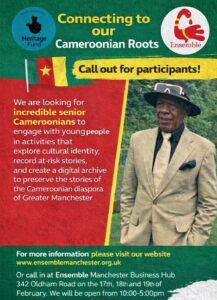
This article explores the migration of Cameroonians to England in the 1960s, a pivotal period marked by African independences and post-colonial dynamics. It aims to analyze the motivations and settlement conditions of this first wave of migrants, highlighting the journeys of the elders of this generation. Particular emphasis will be placed on contemporary challenges in genealogical research within the diaspora, the importance of British civil registers, and the role of Cameroonian cultural traditions, such as the practice of “toqué porte,” in verifying kinship ties and preventing consanguinity. The objective is to provide a rigorous and documented analysis, intended for an institutional, academic, and community audience, to better understand the origins and family trajectories of the Cameroonian diaspora in the United Kingdom.
Historical Context
Political and Educational Situation in Cameroon in the 1960s
The 1960s were a period of profound transformations for Cameroon, marked by independence in 1960 (for French Cameroon) and 1961 (for British Cameroon) [1]. The post-colonial period saw the emergence of new state and educational structures, but also challenges related to nation-building. The educational system, inherited from French and British colonial powers, played a crucial role in training an elite capable of taking the reins of the country. However, opportunities for higher education and professional development remained limited, prompting many young people to seek opportunities abroad [2].
Post-Colonial Relations with the United Kingdom
The relations between Cameroon and the United Kingdom are deeply rooted in colonial history, particularly with Southern Cameroons under British mandate. After independence, these ties persisted, facilitating migration to the former metropolis. The United Kingdom, facing labor shortages in various sectors, maintained a relatively open immigration policy for Commonwealth citizens until the early 1960s [3].
Profiles of Early Migrants
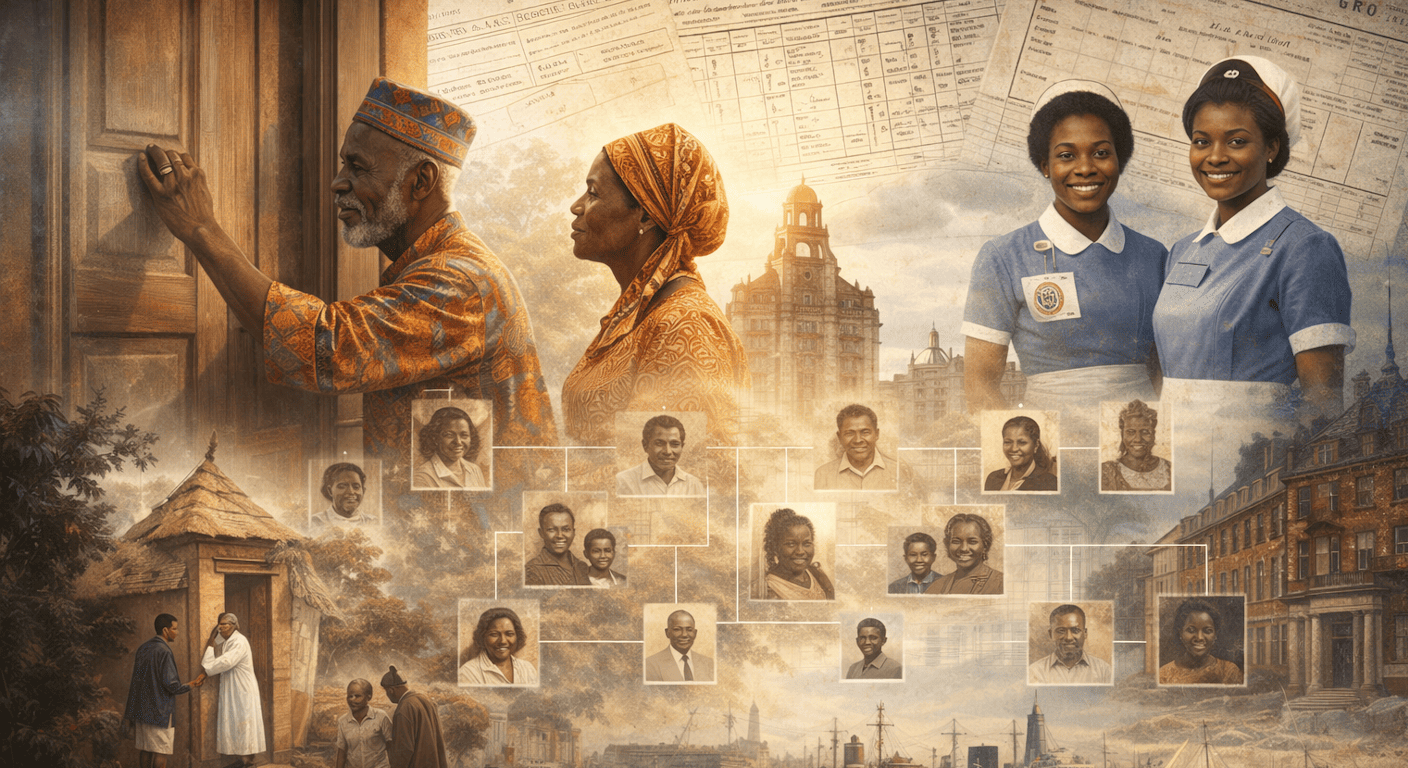
The first Cameroonian migrants who arrived in England in the 1960s were often students, skilled workers, healthcare personnel (especially nurses), and sailors [4]. Attracted by educational and employment opportunities, they helped fill labor shortages in the British National Health Service (NHS) and other industries [5].
Settlement Conditions in England
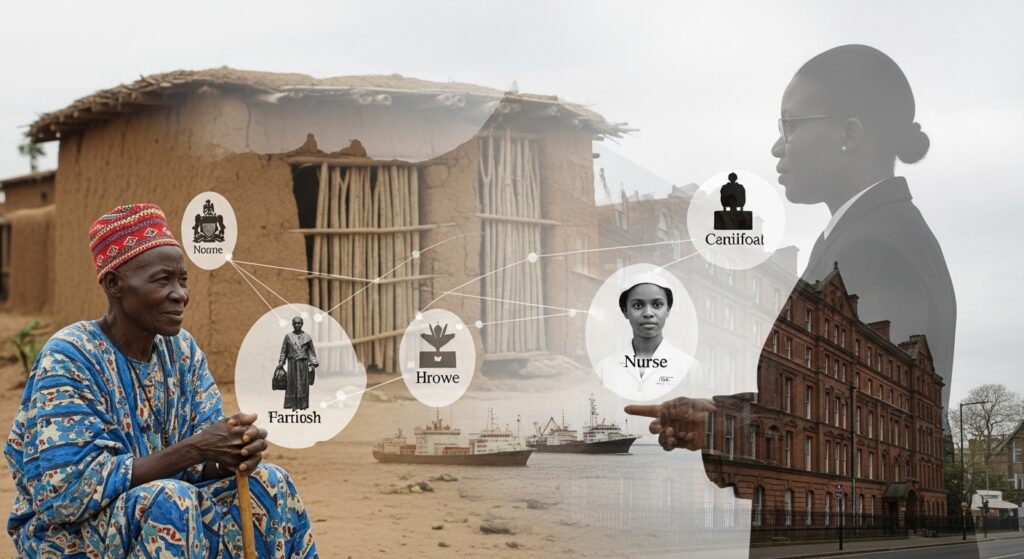
Settlement in England was marked by adaptation challenges to a new cultural and social environment. Migrants often gathered in urban areas, particularly in port cities like London and Liverpool, where pre-existing African communities could offer some support [6].
Settlement and Integration
Access to Employment
Access to employment was a key step in integration. Cameroonians, often qualified, found positions in the healthcare sector, transport, and industry. However, they also faced discrimination and barriers to the recognition of their qualifications [5].
Mixed or Intra-Community Marriages
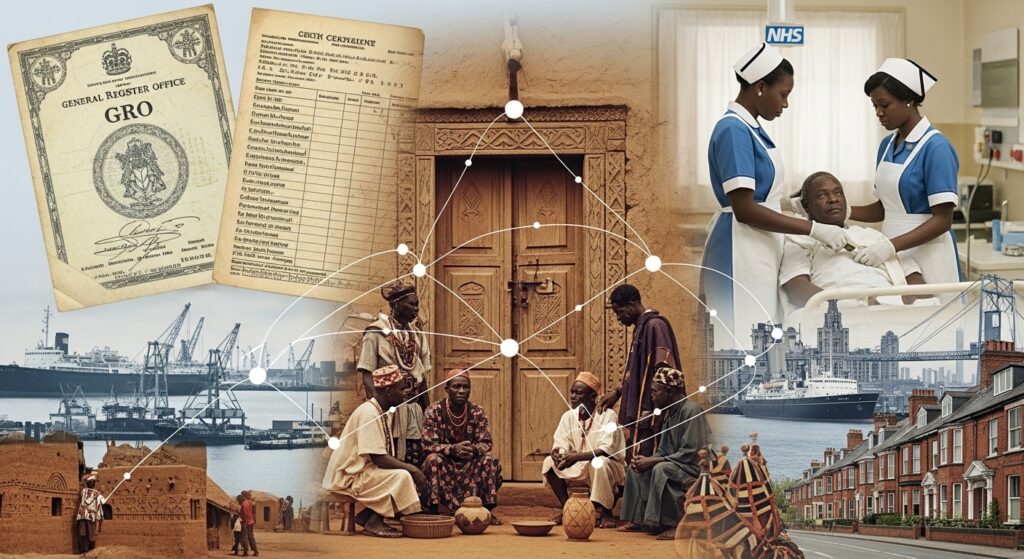
Marriages, whether mixed or intra-community, played a significant role in the formation and expansion of Cameroonian communities in England. They contributed to the establishment of family and social networks, essential for integration and the maintenance of cultural ties.
Settlement in Specific Cities
Although specific data for the Cameroonian diaspora in the 1960s is scarce, African migrants in general often settled in urban areas and industrial cities. London, Liverpool, Manchester, and Cardiff are examples of cities where African diaspora communities developed [6].
Participation in Religious and Associative Life
Religious and associative life offered an important framework for mutual support, the preservation of cultural traditions, and the creation of social ties. Churches and community associations became pillars of integration, providing spaces for meeting and mutual aid.
Evolution of Social Status Over Several Decades
Over the decades, the social status of early migrants and their descendants evolved. Many succeeded in establishing themselves professionally and socially, thus contributing to the economic and cultural development of the United Kingdom, while maintaining ties with their country of origin.
Contemporary Genealogical Research
Growing Interest of the Younger Generation in Family History
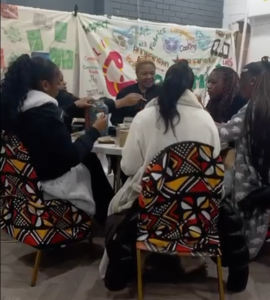
The younger generation of the Cameroonian diaspora in the United Kingdom shows a growing interest in its roots and family history. This quest for identity is often motivated by the desire to understand their cultural heritage and connect with their ancestors [7].
Use of British Births, Marriages and Deaths (BMD) Registers
British registers of births, marriages, and deaths (BMD) are essential tools for genealogical research. The General Register Office (GRO) is the main source for obtaining certificates and information on these vital events [8]. These registers make it possible to trace family lines and document key events in the lives of migrants and their descendants.
Role of the General Register Office (GRO)
The GRO holds civil registers for England and Wales since 1837. It is possible to order copies of birth, marriage, and death certificates online, which is fundamental for building a family tree [8].
Access to Local and National Archives
In addition to the GRO, local and national archives in the United Kingdom (such as The National Archives) offer a wealth of documents that can assist in genealogical research, including censuses, parish registers, and immigration documents [7].
Importance of Church Archives and Censuses
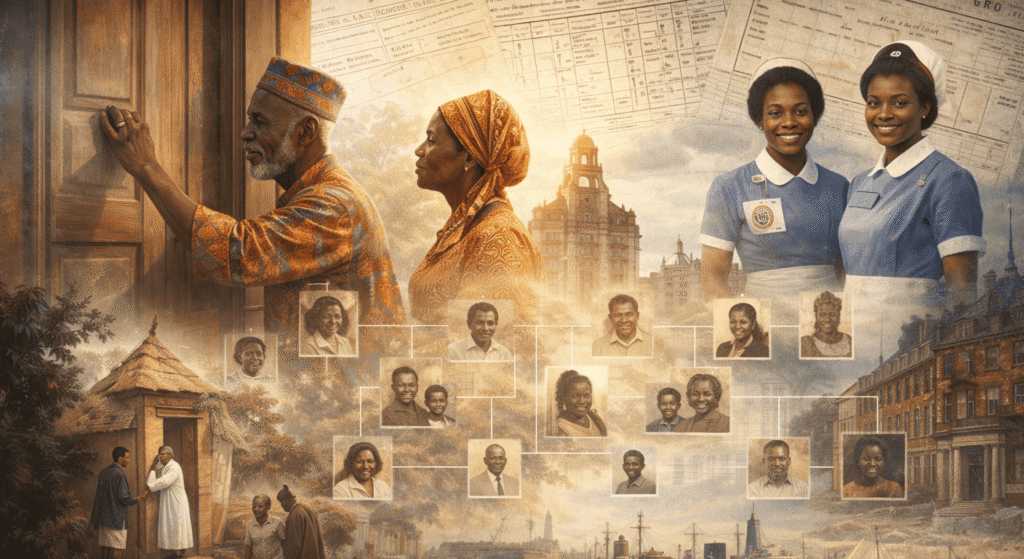
Church archives can contain registers of baptisms, marriages, and burials, thus complementing information from civil registers. Censuses, conducted every ten years, provide snapshots of households and families, offering valuable details on family composition, occupations, and places of residence.
Identity, Descent, and Transmission
Identity Challenges for Descendants Born in the United Kingdom
The descendants of Cameroonian migrants born in the United Kingdom often face complex identity challenges, navigating between their Cameroonian heritage and their British identity. Genealogical research can play a crucial role in building a balanced identity and understanding their place in the world.
Understanding Family Lineages
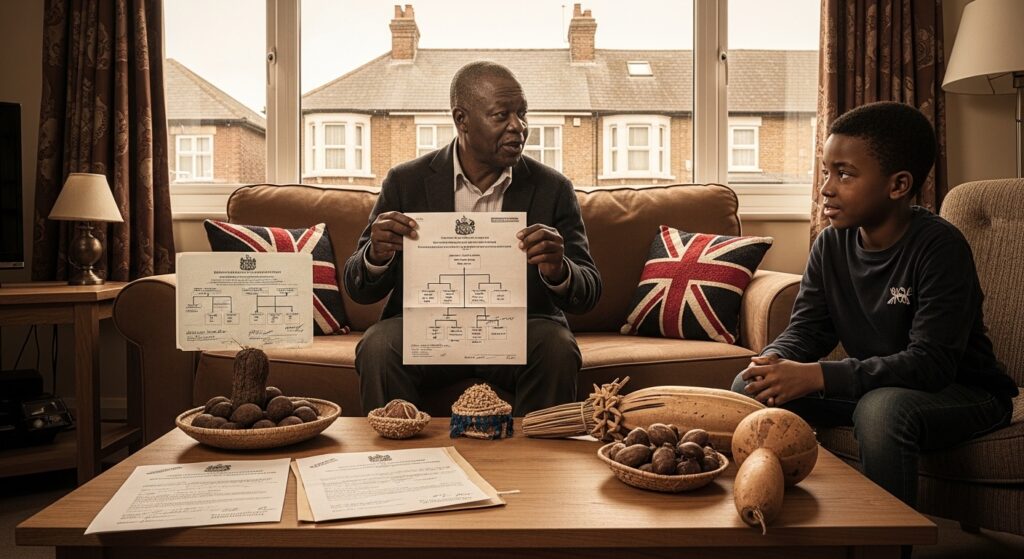
Understanding family lineages is essential for the intergenerational transmission of history, values, and traditions. It helps create a sense of belonging and continuity, strengthening ties within the diaspora.
Intergenerational Transmission
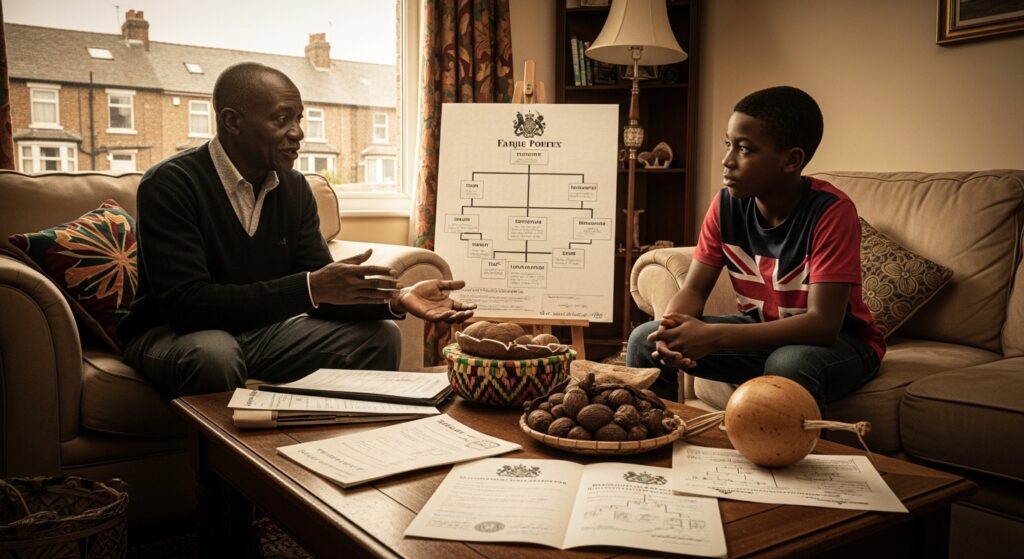
The intergenerational transmission of knowledge and cultural practices is vital for the sustainability of Cameroonian heritage. Genealogical research can serve as a catalyst for family dialogues, allowing younger generations to learn from their elders and preserve their heritage.
The “Toqué Porte” Tradition
Anthropological Explanation of this Cameroonian Practice
The “toqué porte” (or “knocking on the door”) is a Cameroonian cultural practice, particularly present in marriage proposal ceremonies. Anthropologically, it is a preliminary step where the suitor’s family visits the young woman’s family to express their intention and initiate discussions. It is a moment of mutual recognition and verification of family ties [9] [10].
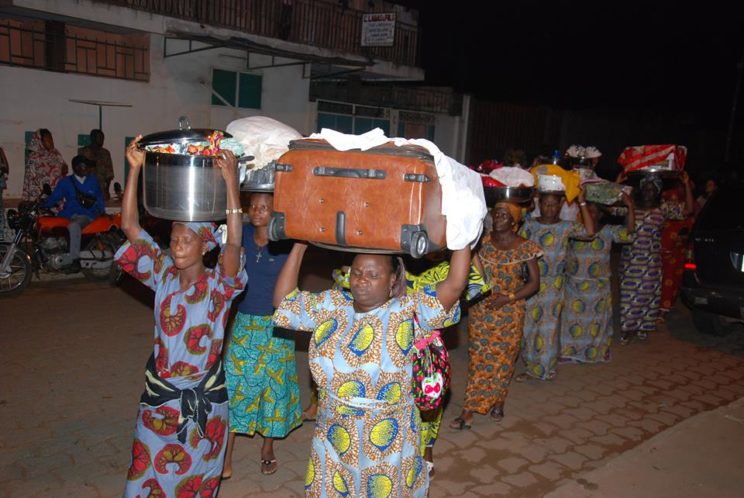
Social Function of Verifying Family Ties
This tradition has a primary social function: it ensures the absence of consanguinity between future spouses. Families exchange information about their respective lineages, origins, and histories, to prevent unions between genetically close individuals, which is a major concern in many African cultures for health and social cohesion reasons [11].
Prevention of Consanguineous Unions
The prevention of consanguinity is a fundamental aspect of “toqué porte.” By verifying family trees and kinship ties, this practice helps maintain genetic diversity and avoid the risks associated with marriages between close relatives.
Possible Adaptation in a Diasporic Context
In the diasporic context, the practice of “toqué porte” can adapt to the realities of geographical distance and cultural diversity. Although the forms may evolve, the spirit of verifying family ties and preventing consanguinity remains relevant, and can be supported by modern genealogical research tools.
Critical Analysis
Limitations of Official Archives
Despite their importance, official British archives may have limitations for diaspora genealogical research. Names may have been misspelled, dates approximate, and certain cultural or family information is not always documented. Furthermore, colonial archives can be fragmented or difficult to access.
Risk of Genealogical Errors
The risk of genealogical errors is inherent in any research, especially when sources are multiple and sometimes contradictory. Confronting information from civil registers, church archives, and oral testimonies is crucial to minimize these risks.
Tensions Between Oral Memory and Administrative Sources
There is often a tension between oral memory, rich in family narratives and traditions, and administrative sources, which are more factual but sometimes incomplete. an integrated approach, combining these two types of sources, is necessary for a complete and nuanced genealogy.
Ethical Issues Related to Data Protection
Genealogical research also raises ethical questions, particularly concerning the protection of personal data and the respect for individual privacy. It is imperative to comply with current regulations (such as GDPR) when collecting and using sensitive information.
Methodological Requirements
This article is based on a rigorous methodology, integrating academic and institutional references. British public databases, such as those of the General Register Office, are mentioned as primary sources. A clear distinction is made between established historical facts and interpretations, and numerical data is used when available to support arguments.
Conclusion
The study of Cameroonian migration to England in the 1960s reveals complex trajectories of settlement and integration, shaped by the post-colonial context and the needs of the host country. Contemporary genealogical research offers the diaspora a powerful means to reconnect with its origins, relying on British archives and valuing cultural traditions such as “toqué porte.” By combining these approaches, it is possible to build a richer and more nuanced understanding of Cameroonian identity in the United Kingdom, thus fostering intergenerational transmission and strengthening community ties.
References
[1] Timeline: Cameroon & the “Anglophone Crisis” – USCRI. (n.d.). Retrieved from https://refugees.org/timeline-cameroon-the-anglophone-crisis/
[2] Life in Cameroon. (n.d.). Retrieved from https://refugeevoicesjapan.com/narrators/patrick/life-in-cameroon/
[3] Miles, R., & Cleary, P. (1992). Britain: Postcolonial Migration in Context. In Immigration Continent: Policies and Politics in …. Retrieved from https://books.google.com/books?hl=en&lr=&id=vG485kRrTUYC&oi=fnd&pg=PA153&dq=Cameroon+UK+post-colonial+relations+1960s+migration+policy&ots=JhdDCdaPAe&sig=IfVO4I23D14yLcZJ4uQsmd2AkYM
[4] Migration and the globalisation of health care: The health worker exodus?. (n.d.). Retrieved from https://www.elgaronline.com/downloadpdf/monobook/9781847207371.pdf
[5] Immigration and the National Health Service. (n.d.). Retrieved from https://historyandpolicy.org/policy-papers/papers/immigration-and-the-national-health-service-putting-history-to-the-forefron/
[6] THE AFRICAN DIASPORA POPULATION IN BRITAIN. (n.d.). Retrieved from http://ndl.ethernet.edu.et/bitstream/123456789/24570/1/75.pdf
[7] African ancestors – an overview. (n.d.). Retrieved from https://www.nationalarchives.gov.uk/help-with-your-research/research-guides/african-ancestors-an-overview/
[8] Research your family history using the General Register Office. (n.d.). Retrieved from https://www.gov.uk/research-family-history
[9] Le toquer-porte, cérémonie traditionnelle de demande en mariage, continue de rapprocher les familles camerounaises. (n.d.). Retrieved from https://www.facebook.com/NouvelleAubeFrancais/videos/le-toquer-porte-c%C3%A9r%C3%A9monie-traditionnelle-de-demande-en-mariage-continue-de-rappr/1189625269776361/
[10] Le toquer porte chez les bantous quelle symbolique hier et aujourd’hui?. (n.d.). Retrieved from https://tamtamdumboa.com/le-toquer-porte-chez-les-bantous-quelle-symbolique-hier-et-aujourdhui/
[11] Gnonlonfoun, Y. (2022). Le rôle de la pratique dans la formation du droit coutumier en Afrique subsaharienne : cas du Bénin. Retrieved from https://theses.hal.science/tel-04131769v1/file/2022PERP0002.pdf