CAMEROON
Located in Central Africa, Cameroon is bordered by Equatorial Guinea, Gabon and the Congo to the South, by the Central African Republic and Chad to the East, and by Nigeria and the Atlantic Ocean to the West.
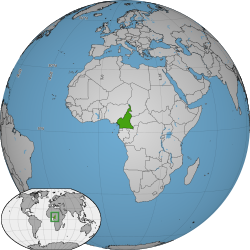
The country has an area of 475,442 square kilometres and is divided into 10 regions, 58 departments and 360 districts. The capital is Yaounde, located in the south-central part of the country and Douala is the largest city. The country’s name derives from Rio dos Camaroes (River of Shrimps). The name given to the River Wouri by the 15th century Portuguese explorer Fernando Po.
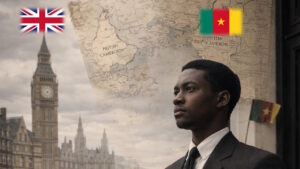
With a population estimated at 25 million, the country has been described as an “ethnic crossroads” because of its more than 200 different ethnic groups. There are 3 main linguistic groups: The Bantu speaking peoples of the south, the Sudanic-speaking peoples of the north, and those who speak the semi-Bantu languages, situated mainly in the west. Within these 3 linguistic groups are 250 tribes including the Bantu, Bamileke, Bamoum, Foulbe and Kirdis. The official languages of the country are French and English. The nation strives towards bilingualism, but very few Cameroonians speak both French and English; following the defeat of Germany during World War 1 Cameroon was partitioned between France and the United Kingdom in 1916 and those two countries administered the territory as mandated/trust territories (in other words as colonies) .
On 1st January 1960, Cameroon gained independence from the French, and on October 1, 1961, from the English, thus forming the Federal Republic of Cameroon. However, the formerly French and British regions continued to keep significant autonomy over the country.
In 1972, a new constitution was established replacing the federation with a unified state called the Republic of Cameroon.
The tourist potential of Cameroon is considerable. The country’s many attractions include the Waza National Park in the north, which was originally created for the protection of elephants, giraffes and antelopes now overflows with both forest and savannah animals. The Dja Faunal Reserve, in the south of the country, is one of the best-protected rainforests in Africa and was designated as a UNESCO World Heritage Site in the late 1980s.In the Bamileke region there are museums devoted to the traditional chiefdoms of the country including the royal palace of the Sultan of Bamoun.
ENSEMBLE MANCHESTER (TOGETHER MANCHESTER)
Ensemble Manchester is a registered charity set up to promote education in all aspects of French African culture.
Our aims are to build bridges that help connect older and younger generations through the beauty and cultures of French speaking Africans.
& to improve the health, wellbeing, skills, aspirations, community cohesion and integration of the African Francophone Communities through educational, cultural and skills-based activities.
Ensemble’s ‘Connecting to our Cameroonian Roots’ project has received Heritage Lottery Funding to engage older and younger participants in activities that explore cultural identity, record at risk stories and preserve the cultural Heritage of the Cameroonian Diaspora of Greater Manchester. Prior to the Connecting to our Cameroonian Roots project, we we successfully delivered our first heritage project “Unity and Community in Football: Celebrating Cameroonian Heritage” with mission to educate the young African people, especially those of Cameroonian origin, into the rich history and culture of Cameroon. In order to do this, it decided to focus on the Cameroonian football which has received some international attention following the relative success of its National Football Team.
‘THE INDOMITABLE LIONS’
This was the name given to the Cameroon National Football Team in 1972 by the then Youth and Sports Minister, Felix Tonye.
‘The Indomitable Lions’ are Africa’s most successful footballing nation on the international stage. They qualified 8 times for the FIFA World Cup (in 1982, 1990, 1994, 1998, 2002, 2010, 2014 and 2022). They have also won 5 African Cup of Nations titles (1984, 1988, 2000, 2017) and an Olympic Gold Medal in 2000 in Sydney, Australia.
The team’s most notable performance was at the World Cup in Italy in 1990, when the team beat Argentina, the reigning champions at that time, in the opening game. Cameroon eventually lost in extra time in the Quarterfinals to England.
LEGENDS OF CAMEROONIAN FOOTBALL
These are former Cameroonian players who have distinguished themselves by their participation in national and international football games and by the quality of their individual performances.
The legends chosen are:
Samuel Mbappe Leppe
Roger Milla
Joseph Antoine Bell
Thomas N’Kono
Cyrille Makanaky
Marc-Vivien Foe
Emmanuel Kunde
SAMUEL MBAPPE LEPPE
Samuel Mbappe Leppe was an international football player. In 1965 he was the first captain of the Cameroon National Team to lift the trophy in the first tournament of the African Champion Club Cup, the predecessor of the African Champions League.
According to some of his teammates and fans of Cameroonian football in the 1960s, Mbappe Leppe was an exceptional midfield player with an uncanny ability to find the back of the net with explosive power and deadly accuracy. He was part of the Oryx de Douala team that won 5 Champions of Cameroon titles (1961, 1963 – 1965, 1970).
Richard Ekoka Sam Ewande, former sports leader, likened Mbappe to a marshal in the army – the one who takes command – because Mbappe commanded every game he played in “not because he was the strongest but because he was the best player”.
Jean Paul Akono, a former teammate of Samuel Mbappe Leppe, talked about Mbappe’s fighting spirit. He said Mbappe was a man who did not like defeat and had forged a determination to win. He always gave of his best and encouraged his teammates to do the same.
Roger Milla said that Mbappe was a phenomenal football player who was able to find the opportunity to score goals on a regular basis.
In a television documentary “Marshal Mbappe Leppe: Ups and Downs of an Icon”, Paul Ngougnou, a CRTV journalist, commented that everyone who watched Mbappe play could see this “god of the football stadium” had a strong will – the will to win.
Mbappe died on 25 December 1985 in Douala and in memory of the Samuel Mbappe Leppe’s life and contribution to Cameroonian football Akwa Stadium in Douala, Cameroon was renamed the Samuel Mbappe Leppe Stadium.
In 2015 Mbappe Leppe was awarded the title of ‘Legend of African Football 2015’ by the Confederation of African Football (CAF).
ROGER MILLA
Roger Milla was born on 20 May 1952 in Yaounde, with dual nationality: Cameroonian and French. He began his footballing career as a 13-year-old at Éclair de Douala, moving to Leopard Douala 5 years later. In 1977 he moved to France playing in several French clubs including Valenciennes, Saint-Etienne and Montpellier.
Roger Milla was one of the first African players to be well-known on the international stage. He is recognised as one of the most emblematic footballers from Cameroon. He was capped 63 times for the National Team and scored 37 goals. He was an outstanding centre-forward renowned for his impeccable technique and grace under pressure.
The ‘old lion’, as he was affectionally known, retired in January 1988. In 1990, the President of Cameroon, Paul Biya, pleaded with him to come out of international retirement and re-join the national team. So, at the age of 38, he played with the ‘Indomitable Lions’ in the Italia 90 World Cup, scoring 4 goals as the team progressed to the Quarterfinals.
At the age of 42, he was recalled again to play for his nation in the 1994 World Cup held in the USA. This time however, Cameroon did not progress further than the group round, but Roger Milla left his mark on the game by becoming the oldest world cup goal scorer of all time as he grabbed his side’s consolation goal in their game against Russia. (6-1).
He is also remembered for celebrating each of his goals with a dance around the corner flag. This has since become a popular goal celebration the world over.
During his long sporting career, he was given many accolades:
1976: African Footballer of the Year
1986: Top scorer in the African Cup of Nations
2001: Cameroon’s Best Player of the Century
2004: Named in the FIFA 100 list of the world’s greatest living footballers at the FIFA Centenary Celebrations by Pele.
2006: Awarded Knight of the Legion of Honour by France
2007: Named Best African Player of the previous 50 years by the Confederation of African Football (CAF)
After finally retiring from football, resides in Cameroon and is the founder of a football academy, ‘Heart of Africa Solidarity: Roger Milla Foundation’ He is also a Goodwill Ambassador for African Causes and Sports Advisor to the President of the Republic.
JOSEPH ANTOINE BELL
JoJo, as he is known, was born on 8 October 1954 in Mounde, a village in the Ngambe commune and home to the Bassa tribe. He has dual nationality: Cameroon and French.
He began his footballing career as a 15-year-old at Éclair de Douala, moving to Oryx Douala before joining Union Douala in 1975. In a 20-year career he played in the Ivory Coast (Africa Sports National) and Egypt (Al-Mokawloon al-Arab) before moving to France in 1985. Here he played for several top-level clubs including Olympique de Marseille, Sporting Toulon Var and F.C. Girondins de Bordeaux before he ended his playing career with Saint-Etienne.
He represented the Cameroon National Team in 3 World Cups, the 1984 Summer Olympics in the USA and several African Cup of Nations matches. He was a member of the ‘Indomitable Lions’ team that won their first African Cup of Nations by beating Nigeria in 1984. He was a spectacular goalkeeper with ‘cat-like’ qualities, which won him the title of ‘African Goalkeeper of the Century’ by the International Federation of Football History and Statistics (IFFHS) in 1999.
Joseph Antoine Bell announced his retirement at a press conference on 25 June 1984. It was the day after Cameroon had suffered a severe defeat against Brazil (0-3) JoJo had not played in that match.
During his stay in France, Joseph Antoine Bell qualified as a public works engineer, a profession he turned to in his retirement. He also worked at FIFA, Channel Plus TV. He works now a consultant at RFI Et Afrique 24.
In his native village of Mounde, JoJo is a Mbombog (a tribesman of ancestral and mystical powers) which is equivalent level of a third-degree village chief.
THOMAS N’KONO
Thomas N’Kono was born on 20 July 1956 in Dizanque. He is one of 8 children and due to his family’s limited finances he started work in shoe-making workshop to help support the family. At the age of 17, N’Kono joined Éclair de Douala football club.
After playing in Cameroon with Canon Yaounde and Tonnerre Yaounde, Thomas ‘Tommy’ N’Kono moved to Spain in 1992 to play for RCD Espanol. He was the first black African goalkeeper to achieve international recognition in Europe. His goalkeeping style was instinctive and aggressive. He was particularly well known for his quick reactions and acrobatic saves.
Tommy N’Kono stayed in Spain for over a decade, playing for several Spanish clubs until he moved to Bolivia in 1994. There he joined Paz Bolivar and was part of team that won 2 championship titles in South America.
Thomas N’Kono came to the attention of the Cameroon National Team when Joseph Antoine Bell missed several qualifying matches for the World Cup in 1982. This was due to Bell studying for a civil engineer qualification in France. N’Kono played for the ‘Indomitable Lions’ in 3 World Cups and 4 Africa Cup of Nations tournaments.
Thomas N’Kono retired in 1997 and returned to Cameroon to become the goalkeeping coach for the national team.
CYRILLE MAKANAKY
Cyrille Makanaky was interviewed in Manchester on 25 April 2018 by a young Ensemble Manchester volunteer. Makanaky gave the following account of his life and career as a professional footballer.
He was born on 24 June 1965 in Douala, Cameroon. He first started playing football on the streets of his hometown when he was 6 years old. It was there he found his passion for the game, but at that time he had no ambition to become a professional footballer.
By the age of 17, Makanaky had moved to France and was playing in amateur football clubs around the Paris area. Impressing at the amateur clubs of Saint-Leu and Gazelec Ajaccio, he went on to play in the French first division with Toulon and then Lens. It was here that Makanaky decided to fully commit to a career as a professional footballer. He was a talented attacking midfielder with an impressive goal scoring record.
In 1987, Cyrille Makanaky joined the Cameroon National team appearing in 2 Africa Cup of Nations tournaments. In the 1988 tournament, held in Morocco, Makanaky scored the only goal in the semi-final game against the host nation enabling the ‘Indomitable Lions’ to lift the trophy in the finals.
He represented Cameroon in the 1990 World Cup in Italy, playing in all 5 matches as the team reached the quarter finals. After that World Cup appearance, Makanaky moved to Spain playing for the second division clubs Malaga and Villareal.
He also played in Israel with Maccabi Tel Aviv F.C. and in Ecuador for Barcelona Sporting Club. He played two spells for Barcelona Sporting Club helping them to win the national league on both occasions.
In 1997, Cyrille Makanaky retired from professional football at the age of 32.
MARC-VIVIEN FOE
He was born on 1 May 1875 in N’Kolo, a district of Yaounde. He had dual nationality: Cameroon and French. He became a naturalised French citizen in December 1998. Marc-Vivien Foe’s started playing football as a junior at second division Union Garoua in 1991 and continued at Fogape in 1992. Moving to Canon Yaounde, one of the biggest clubs in Cameroon, he helped them win the Cameroonian Cup in 1993.
In 1994, Marc-Vivien, affectionately known as Marco, moved to France to play at the Mount Peller club. He stayed with this club until 1999. He was included in the Cameroon National team for the 1994 World Cup in the United States, playing in all 3 of their matches.
His talent and passion for football brought him to the attention of several English football clubs who became interested in signing him up to play for them. In 1999 he moved to the English Premier League club West Ham United, returning to France in 2000 to join Lyon. Marco returned to the English Premier League when he was loaned to Manchester City for the 2002-2003 season with a transfer fee of £550,000.
On 26 June 2003, in the 72nd minute of the 2003 FIFA Confederations Cup semi-final between Cameroon and Colombia, in the Gerland Stadium in France, Marc-Vivien Foe collapsed. He was rushed to hospital and was pronounced dead several hours later from a congenital heart condition.
Marc-Vivien Foe’s sudden death whilst in the middle of a competitive international match, came as a shock to the football community worldwide. Numerous tributes to his joyous personality and infectious humour were expressed in a variety of ways.
In the final against France, Cameroon wore shirts embroidered with Foe’s name and dates of his birth and death.
He was given at state funeral in Cameroon
His first club Lens named an avenue after him and decided to withdraw the number 17 shirt that Foe had worn whilst playing for them.
At Manchester City’s former ground, Maine Road, there is a small memorial stone to him in the stadium’s memorial garden.
He was posthumously decorated by Cameroon as a Commander of the Order of Valour.
Marc-Vivien Foe was a true ‘Indomitable Lion’ in the history of Cameroonian football.
Emmanuel Kunde
He was born 15 July 1956 in the town of Ndom in the north-west region of Cameroon. He began playing amateur football in 1973, first with the Mbankomo club, followed by Tempete de Nanga-Eboko and Oylmpic Mvolye. His professional career, as a defender, started when he played for Canon Yaounde where he spent most of his footballing career.
In 1987 he went to France to begin his professional career with Stade Lavallois (1987-1988), moving to Stade Reims in !988 (1988-1989). In 1980 he was selected for the Cameroon National Team and played his first match with the ‘Indomitable Lions’ at the 1982 World Cup in Spain.
He played in the final against Nigeria in 1984 African Cup of Nations in the Ivory Coast, where Cameroon won its first championship (3-1). At the 1988 African Cup of Nations, Cameroon once again faced Nigeria in the finals. Kunde’s goal from a penalty kick won the tournament and the ‘Indomitable Lions’ won their second title (1-0).
Two years later, in the 1990 d’Italia World Cup quarter final match against England, he scored to equalise (1-1) again from a penalty kick.
In 1992 Emmanuel Kunde retired from playing football to focus on a career in football coaching with his former club Canon Yaounde